
Native Plant Sale
Native plant gardening is a hot topic right now thanks, in large part, to ecologist Doug Tallamy. Through his book Nature’s Best Hope and his ground-roots Homegrown National Park initiative, Tallamy has brought a greater awareness to the plight of our local wildlife, particularly our native pollinators. According to Tallamy, we can reverse much of the damage caused to the environment if each of us takes action to regenerate biodiversity by choosing to plant native.
So, what is the big deal about using native plants in our landscapes?
- Native plants support resilient communities of diverse life and sustain biodiversity
- Native plants have co-evolved within their native environment so they can better adapt to environmental changes.
- Native plants provide familiar and nutritionally valuable sources of food and shelter to wildlife, including our essential pollinators.
- When planted thoughtfully and intentionally, native plants offer an abundance of color, texture, and seasonal interest to any landscape.
- When planted in the right habitat, native plants require less watering and NO fertilizers.
What exactly does native plant mean?
All native plants once grew only in the wild, but not all plants found in the wild are native plants. Here are some definitions to clarify the differences:
- Native Plant: any plant species that has evolved naturally in an ecosystem
- Exotic/Alien Plant: through human intervention, a plant introduced from another area or country – accidentally or purposefully
- Naturalized Plant: an exotic plant that has escaped cultivation and now grows in the wild.
- Invasive Plant: an exotic/alien plant that competes vigorously with other species and has the ability to crowd out all other species, creating a monoculture and whose introduction causes, or is likely to cause, economic or environmental harm or harm to human health.
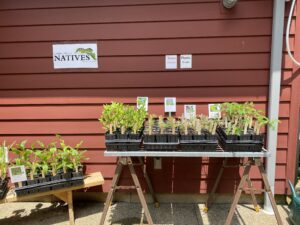
To help folks on their native plant landscaping journey, Friends of Medina County Parks has teamed up with local native plant growers Camel Creek Natives to host annual plant sales to provide access to reasonably-priced, ecologically important native plants. The sale doubles as a fundraiser with proceeds being used to help fund various projects and programs for the park district. In 2025, Friends received $15,200 from sales!
Native Plant Festival and Sale
Saturday, September 5
Oenslager Nature Center
6100 Ridge Road, Sharon Township (use Wadsworth for GPS)
10 a.m. to 3 p.m.
Forbs & Grasses
Allegheny monkeyflower
Aromatic aster
Big leaf aster
Blue lobelia
Brown-eyed Susan (R. triloba)
Butterfly weed
Calico aster
Calico beardtongue
Cardinal flower
Common ironweed
Common milkweed
Dense blazing star
Foxglove beardtongue
Hairy wood mint
Hoary mountain mint
Hollow Joe-pye weed
Indian tobacco
Jacob’s ladder
Lance-leaved coreopsis
Late figwort
Little bluestem
Lyre-leaved sage
Mistflower
Pearly everlasting
Prairie dropseed
Purple coneflower
Purple giant hyssop
Pussy toes
Riddell’s goldenrod
Royal catchfly
Showy goldenrod
Smooth blue aster
Sneezeweed
Spotted Joe-pye weed
Stiff goldenrod
Swamp milkweed
Tall coreopsis
Tall thimbleweed
Virginia mountain mint
White snakeroot
Wild bergamot
Wrinkle-leaved goldenrod
Zig-zag goldenrod
And a few miscellaneous species!
Shrubs & Trees (quantities of some are limited):
Black willow
Bladdernut
Buttonbush
Bur oak
Kentucky coffee tree
New Jersey tea
Paw paw
Pin oak
Redbud
Scarlet oak
Shrubby St. John’s wort
Swamp white oak
Sycamore
Red oak
White oak
“All plants are not created equal, particularly in their ability to support wildlife. Most of our native plant-eaters are not able to eat alien plants, and we are replacing native plants with alien species at an alarming rate, especially in the suburban gardens on which our wildlife increasingly depends. My central message is that unless we restore native plants to our suburban ecosystems, the future of biodiversity in the United States is dim.” ~From Bringing Nature Home by Doug Tallamy